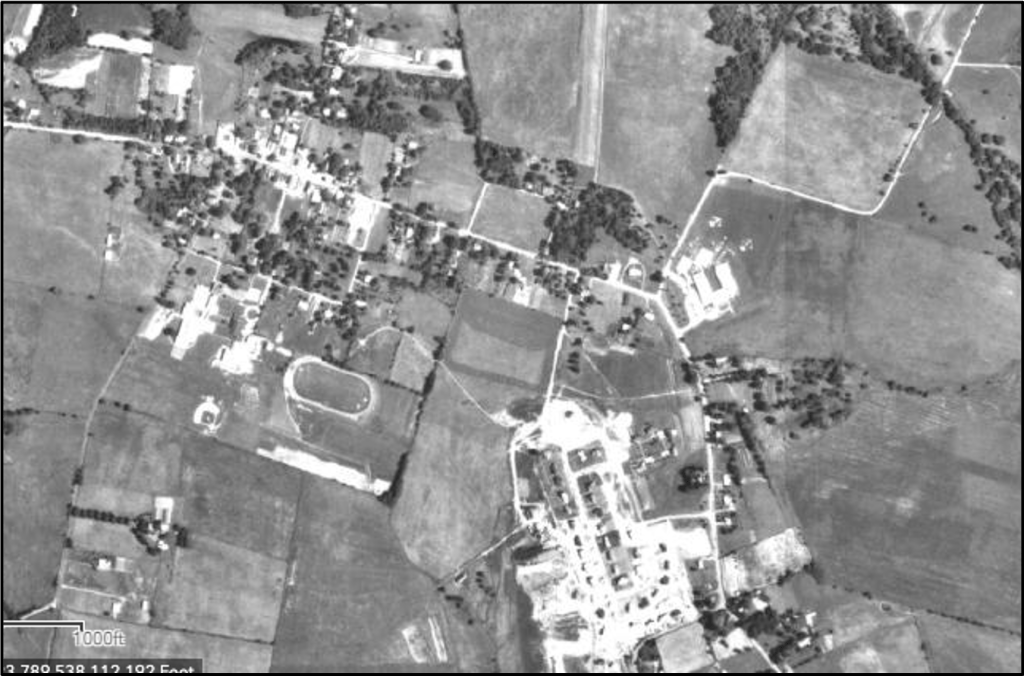
The Poolesville Town Commissioners, in conjunction with various town boards, are currently developing the town’s master plan, required for publication every ten years. As we begin to think about how we want our town to evolve over the next ten years, it’s probably a good time to consider how we arrived here in the first place.
Development in Poolesville has been a contentious issue in town over the last few years. I frequently joke that if you want people to show up for town hall meetings, just propose a new development. But it is somewhat interesting to look at neighborhood development over the last 50 years, because prior to 1970, this town saw very little change from its incorporation in 1867. According to census information, the population in 1900 was around 230, in 1970 the population was around 350, and today the population is around 5,500.
So what changed in 1970 and what has development in town looked like since then? In order to briefly explain these last 50 years, I break our town’s growth into three distinct eras: The Halmos Era, which lasted from 1970 – 1976; the McDonald’s Era, which lasted from 1986 to around 2000; and the Post-Great Recession Era, which began around 2010 and is ongoing.
The Halmos Era
In the 1960s, Gene Halmos, a WWII vet and former prisoner of war (you can read his account of being held in a German POW camp in his book “The Wrong Side of the Fence”), became head of the town commissioners. There was frustration with the perception that the town was being pushed around by county officials due to Poolesville’s relative lack of voting power on account of its small population. In an effort to change this dynamic and improve local economic development, Gene and the commissioners embarked on an effort to grow the population through development.
Before developers could come to town however, significant drainage issues throughout town needed to be fixed (residents in the 1940s describe swampy conditions throughout Poolesville anytime it rained). In 1966, a new sewer system was completed to much fanfare – the commissioners held a celebration at the Poolesville Middle-Senior High School to highlight the accomplishment.
With the sewer in place, development was ready to begin, and between 1970 and 1976 the Westerly, Wesmond, and townhouses along Wootton Avenue were built. As these developments came online however, it became clear that despite the new sewer system, our wastewater capacity remained inadequate. So much so that in 1976 the state imposed a moratorium on further development until the capacity issue was fixed.
The McDonald’s Era
In 1984 the new wastewater treatment plant was completed, allowing for the development moratorium to be lifted. Through the late 1980s and into the 1990s development again kicked into high gear with the building of multiple neighborhoods, to include Hunter’s Run, Tama, Elizabeth’s Delight, and Seneca Chase. Exciting as these new developments were, perhaps nothing was more exciting than the completion of McDonald’s in 1989. The Baltimore Sun captured the mood (perhaps a bit over dramatically), when it wrote an article about town titled “Fast Times in Poolesville: Building Ban is Gone and McDonald’s is Coming.”
As building throughout the 1990s continued, the age-old problem of water capacity in Poolesville began to again emerge. Not only were concerns of wastewater capacity again at the forefront of town commissioner and planning board members’ minds, but well water capacity was also beginning to become stretched. The confluence of these issues, combined with a town population increasingly skeptical of further growth, effectively ended this phase of development around the year 2000.
The Post-Great Recession Era
Despite the pause in development beginning around 2000, landowners and developers continued to plan for future development, and by 2007-2008 they were ready to again begin building. By this point in time, well capacity had been largely rectified by the digging of additional wells throughout town and upgrades to the wastewater treatment plant improved some of the wastewater capacity issues previously identified. The global recession of 2008 certainly delayed building, but by 2009-2010 construction on Stoney Springs had begun and Brightwell Crossing was about to break ground.
Despite lingering concerns over wastewater capacity (which according to a former member of the planning board can likely never be completely ameliorated as long as the treatment plant sits along the Dry Seneca Creek), development continues today. Families are moving into the Reserve at Brightwell Crossing and Westerly Grove as we speak and the development on the Willard property in the center of town seems all but certain to be built over the coming years.
Poolesville in 2031
If you spend some time reviewing the town’s master plan from 2011, you will see that the vision depicted in that document has largely come to fruition (kudos to the Town Commission, town boards, and town staff on this!). Given this realized vision, residents should view the opportunity to influence the 2021 plan as a real opportunity to shape how the town proceeds over the next ten years and not some check the block exercise by the town to meet a previously established requirement. What do you hope Poolesville looks like in 2031? Here’s your chance to make that vision a reality.

