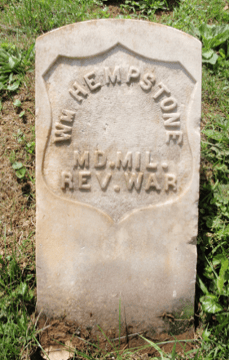
In late 1780, the Revolutionary War was still very much underway. That said, the tide was beginning to turn in favor of the patriots. Private William Hempstone’s service in the 7thMaryland Regiment of the Continental Congress was coming to an end. The records are a bit unclear, but it’s likely William participated in at least one major battle during his time of service – the Battle of Camden, SC (which did not go well for the patriots!). With his obligation served, William was coming home.
William’s father – William Sr. – was one of the earliest settlers on the land we now refer to as the Ag Reserve, then considered part of Frederick County. Returning home from war at the age of 20, William Jr. was ready to start a new chapter as a farmer.
The details of William’s life between 1780 and 1801 are scarce, but we know that he purchased parcels of land near current-day Beallsville with his brother in 1790, 1796, and 1801. It was on this third tract of land, known as “Resurvey on Hanover” in survey records, that William built his home. (You have to wonder if William recognized the irony of a Revolutionary War veteran building a home on land named in honor of English King George I, who was from the House of Hanover).
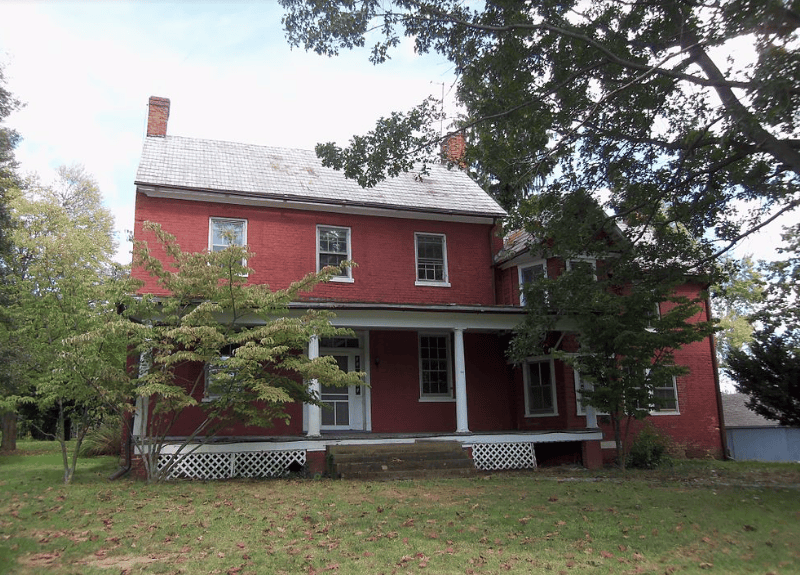
The home, completed around 1804, was built with brick in the Federal style. The floors of the home were constructed with hand-hewn timbers, likely from the surrounding woods of the area. When William and his wife Sarah moved in, it appears they had three children, with four more to follow. A prosperous farmer, the 1810 census shows that William owned 23 slaves – an incredibly large holding for the time. Unfortunately, we don’t have much detail on the names or burial location for these slaves.
In 1895 the home was willed to Caroline – the granddaughter of William – and her husband Charles Greenbury Griffith. Charles was a prosperous farmer who later served as county commissioner in 1903 and in the Maryland Legislature in 1905 and 1919. Over the years, the property was passed from one generation to the next, remaining under the ownership of William’s decedents for five generations until sold out of the family in 1964.
Today, the property sits empty on the grounds of Four Streams Golf Club. Despite its designation on the National Register of Historic Places, the home appears to have fallen into a state of relative disrepair. It’s unclear if Four Streams has a plan for preserving the home (let’s hope!), but it would be a significant loss to the Ag Reserve community if not recovered.

