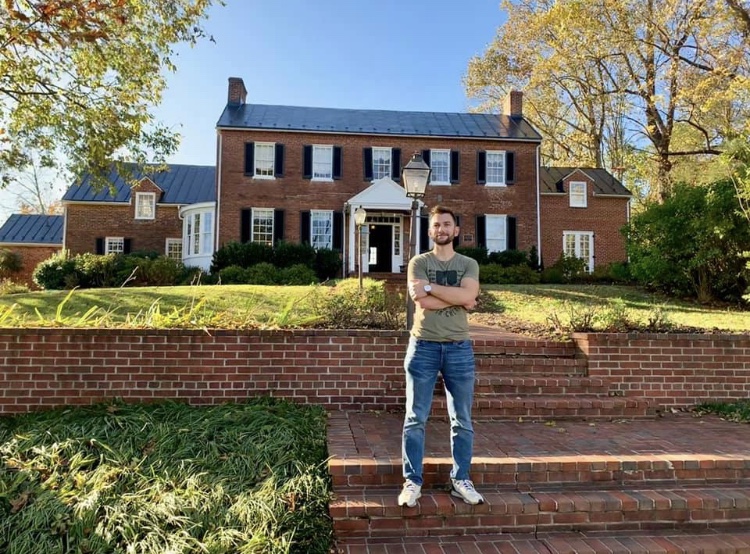
I am pleased to start as the Monocle’s contributing writer for Foundations, a column dedicated to highlighting the history and stories behind historic homes and buildings in the area. Before jumping in, I wanted to take a little time to introduce myself and explain why I think the exploration of our local history – our inheritance – is so important.
I’ve spent the majority of my life here in the Ag Reserve. Growing up, my father and I spent countless hours driving the rustic roads throughout the Medley District. Now grown up and living back in Poolesville, I find myself jumping in the car on a weekly basis to drive the same roads I did as a child, this time with my five-year-old in the backseat. The thing I love most about these explorations is that no matter how well I know this land, I always see something I never noticed before – a stone wall, a small creek, a barn tucked away in the woods, the glimpse of the roofline of an old home I never knew existed.
I bring my five-year-old, Sawyer, for a few reasons. First, it’s a fun way to spend time together. Second, I think it’s important our children grow up understanding the place they come from – good and bad. And finally, and most selfishly, because Sawyer will inevitably ask me a question on every drive that is both simple and profound in ways only a child can verbalize.
A few weeks ago, we were standing on the banks of the Potomac River at White’s Ford. For those of you who know your Civil War history, you know that it was at this spot in the fall of 1862 the Confederate Army crossed the river from Loudon County into the Ag Reserve before marching north to eventually fight at Antietam. After describing this scene to Sawyer, he turns to me and asks, “well, if they crossed the river, where’s the bridge?” After explaining to him the soldiers walked through the water, he took a few minutes to think further on the issue before asking, “if they walked through the water, how did they make sure their robots and drones didn’t get wet?” I’m not sure I know how to even begin answering that one.
Obviously, I expect Sawyer’s grasp of history to improve as he gets older, but the question served as a reminder that with each new generation, our understanding of the past is slightly more biased towards the technologies and experiences of the current. And it’s to this point I’m able to answer the other question my five-year-old asked me that same day on the Potomac, “why do you like old houses so much!?”
The old homes that dot the landscape of the Ag Reserve have literally weathered the test of time. Despite all the changes this region and country have gone through over the decades, these homes have served as a constant – a tangible reminder to all of us about those who came before us. And if we believe the community we live in today is a great place, then we should really spend some time better understanding these people of the past. For it’s these people and the actions they took, both good and bad, that have resulted in the community we have today. And maybe there’s something to be learned from these actions that can help us ensure the community we pass on to our children is even better.
Realizing that I know far too little about the people and events of our collective past, I’ve taken a proactive approach in the last few months to explore the Ag Reserve, with a specific focus on the incredible historic homes we drive past each day. Within these homes lie the stories of this land, and I think it’s incredibly important as a community that we keep these stories alive. To accomplish this, I’m reaching out the owners of historic properties, scouring historic archives, and working to share what I’ve learned with the community. Hopefully you will follow along and share the stories and lessons you hear with others.
You can also follow along on Facebook @HistoricAgReserveProperties, where I continue to post shorter commentary on homes in the area but with more pictures.

