If you’ve never taken an afternoon to explore the grounds at Monocacy Cemetery, this fall would be a great time to do so. Despite growing up in Poolesville, it wasn’t until about a year ago that I ventured inside the gates. The cemetery is the final resting place to veterans of virtually every conflict the United States has fought since the Revolutionary War, noteworthy former citizens of the Ag Reserve, and a large number of family members tied to the historic homes we pass by each day.
In two different sections of the cemetery you will find slabs noting that the tombstones in these sections were “moved from the graveyard at Mother’s Delight.” The tombstones – predominantly bearing the names of Allnutt, Darby, and Dawson family members – span a timeframe of 1797 to 1880.
The Allnutt and Dawson families have significant roots in the Ag Reserve, stretching back to the late 1700s. A number of historic homes in the area have links to members of these families. For example, the next time you are enjoying a glass of wine at Rocklands, take a look at the side of the home above the bay windows and you will see “B. Allnutt” chiseled into the Seneca sandstone wall.
It turns out that the “Mother’s Delight” cemetery was developed in the last few years of the 18thcentury on farmland owned by James Macall Dawson, Sr., who lived from 1775 to 1867. In survey records, the land was referred to as “Mother’s Delight,” hence the name of the cemetery. Following James’ death in 1867, his son Americus inherited the land before passing it on to a nephew, who owned the property until 1924. In the late 1920s, after the land was sold out of the Dawson and Allnutt families, a decision was made to move almost all of the tombstones and about half of the bodies from the graveyard to Monocacy Cemetery (how it was decided which bodies were moved and which were left remains a mystery).
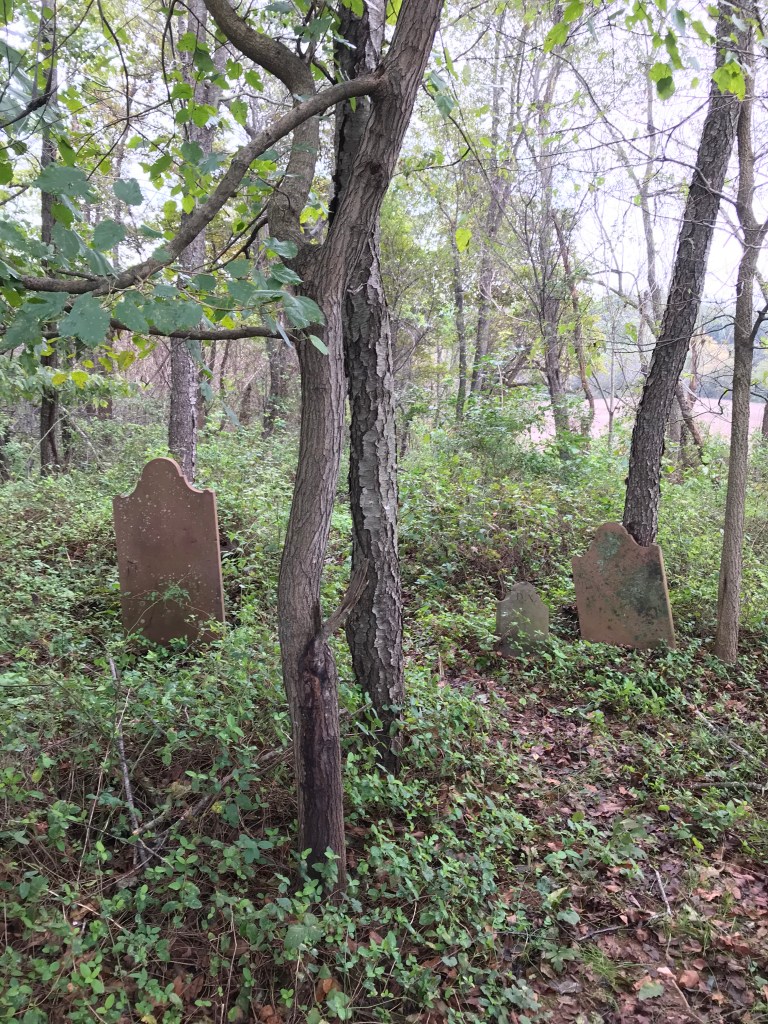
Today, the “Mother’s Delight” cemetery sits in a patch of woods near Boyds. Largely untouched for the last 90 years, nature has overtaken the grounds of what I assume was once a well-manicured cemetery. Interestingly, two gravestones do remain at the site. These two stones, belonging to John Dawson and his son Erasmus, were left at the site for reasons unknown. The men died 10 days apart in December of 1855.

