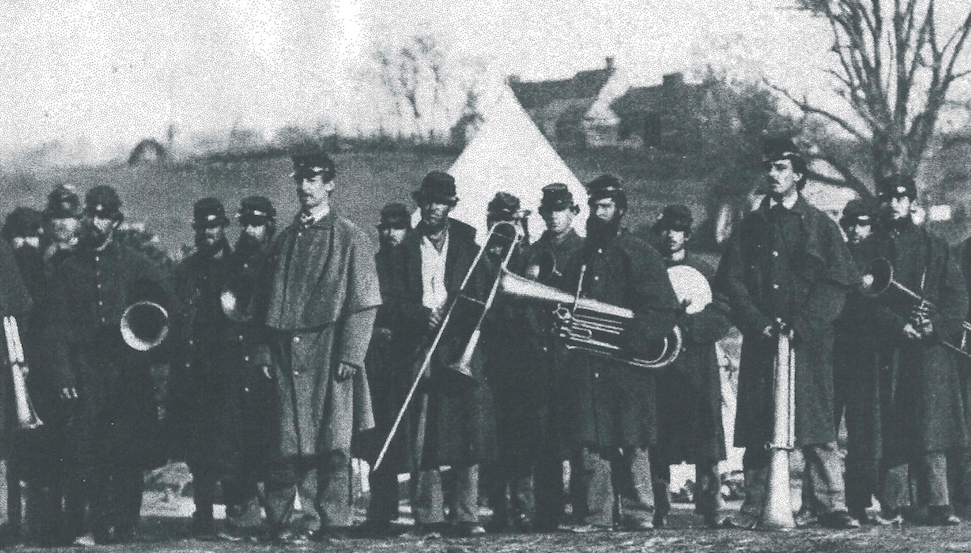
A few years ago, a local historian buddy of mine showed me this interesting black and white photo of what is clearly a military band from the Civil War era. I was told that the band was from the 20th Massachusetts Infantry and that the picture was taken in 1861 at Camp Benton, just outside of Poolesville. This is exactly the kind of picture and storyline that causes me to dive into rabbit holes to learn more. Who were these men? Where exactly was this picture taken – yes, at Camp Benton, but where was that? What more can we learn about the house far off in the background?
First, let’s learn more about the 20th Massachusetts Infantry. Formed in the late summer of 1861, the unit is sometimes referred to as the “Harvard Regiment” because of the number of Harvard College graduates that were among its ranks. This included Oliver Wendell Holmes, who in years after the war, would go on to serve as an Associate Chief Justice on the US Supreme Court. The unit, which fought for the entirety of the Civil War, experienced its initial trial by combat here in the Ag Reserve. Arriving at Camp Benton in September 1861, the 20th was largely responsible for patrolling the shores of the Potomac to ensure confederate forces would not attempt to cross the water and move on Washington. In October, about a month after arriving at Camp Benton, the 20th was involved in the Battle of Balls Bluff – an engagement that went poorly for union forces from the beginning and left many members of the unit as casualties. The 20th would go on to fight in nearly all significant battles throughout the Civil War, to include Antietam, Fredericksburg, Chancellorsville, and Gettysburg. While it’s unclear who specifically the men in this picture were, we can be confident that they saw their fair share of combat and at least some were likely wounded or even killed.
Next, let’s locate Camp Benton. Using Civil War era maps of the area in addition to accounts from letters written by 20th Mass. soldiers, we know the camp was located between Poolesville and Edward’s Ferry. Henry Ropes, an officer in the 20th, kept an extensive account of his time with the unit at Camp Benton via letters that have been preserved (for those who want to learn more about the Civil War and Poolesville, I highly recommend you look them up online). In the letters, Henry notes that the camp was 2 miles from Poolesville. Ultimately, we can pinpoint the location of Camp Benton to a large field sitting to the immediate south of the intersection of Edward’s Ferry Road and Westerly Road (if you are driving from Poolesville to Edward’s Ferry, look to your left when you get to the T-intersection with a stop sign where Westerly ends). Interestingly, it is said (and I have no proof for this!) that there is a spot in this field that to this day will not allow for the growing of crops – blamed on the ground becoming sterile due to a Camp Benton stove that was located on the spot during the war.
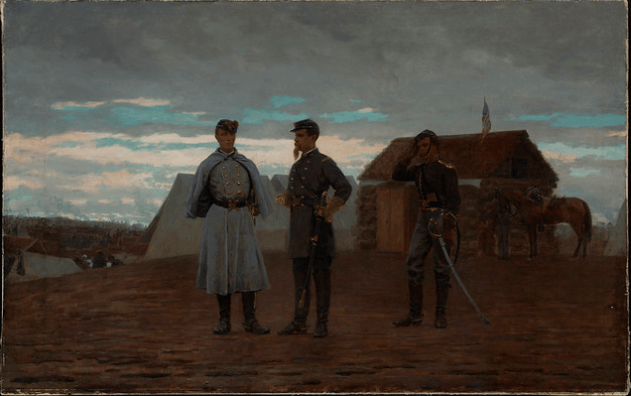
Now that we know more about the band’s unit and the location of where this picture was taken, what can be learned about the home in the background of the picture? From historic records and maps we can be certain this home was the Williams Family Farm. While the farmhouse at this location is certainly an old home, it’s not the same house depicted in the picture. That home was demolished after the Civil War with the current one built in its place. However, what can also be seen (barely) in the historic picture is a small log smokehouse standing next to the farmhouse. This smokehouse is still standing. And adding to the intrigue is the idea that the log structure shown in the famous Civil War artist Winslow Homer’s painting “Officers at Camp Benton, Maryland, 1861” is the same one still standing today. This is likely impossible to prove, but certainly adds an interesting wrinkle to the story.
So, there you have it. These nameless men of the 20th Massachusetts, standing with their instruments in a field just outside of Poolesville at the very beginning of what would become a bloody struggle to preserve the union. I hope the next time you take a drive or bike ride down to Edward’s Ferry you think of them and the sacrifices they made in their short time with us here on the banks of the Potomac.

