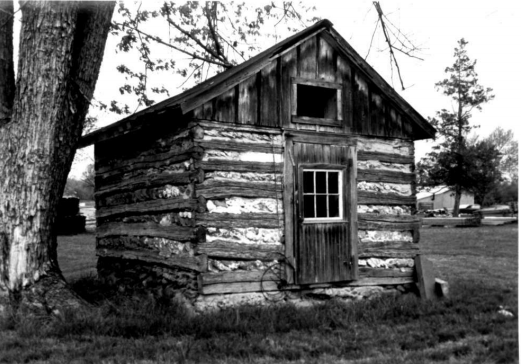
I’m increasingly receiving emails and messages on Facebook from Ag Reserve residents looking for more information on specific old properties. It’s been exciting and interesting to learn of local residents’ interests. While I’ve received a wide-range of requests for information on various structures, one of the most frequently requested is the small log structure at the 4-way intersection in Beallsville.
I’ve got to be honest and say that the continued expressed interest in this small structure confused me. It’s so small and relatively insignificant looking, why does anyone care about it, I thought. Upon highlighting this point to my wife – who is infinitely more insightful and thoughtful than I – she reminded me that the structure’s prominent location at the 4-way stop combined with the very old looking nature of the logs and small size of the structure has likely generated curiosity in ways that larger homes hidden at the end of long driveways cannot. So, reluctantly at first, I began digging in to understand the history of this log structure. Much to my surprise, its story is quite interesting.
Upon reviewing the Maryland Historic Trust’s write-up on the Beallsville Historic District, we learn that in the late 1800s, John Belt and Francis Griffith ran a small country store out of a home that was built in 1872 and torn down in 1983. This home would have stood directly in front of the log structure. While John ran the store, Francis served as the Postmaster for the area. The write-up also notes that the log structure was a smokehouse and was likely built around the same time as the home in the late 1800s – enabling John to sell smoked meat from his storefront.
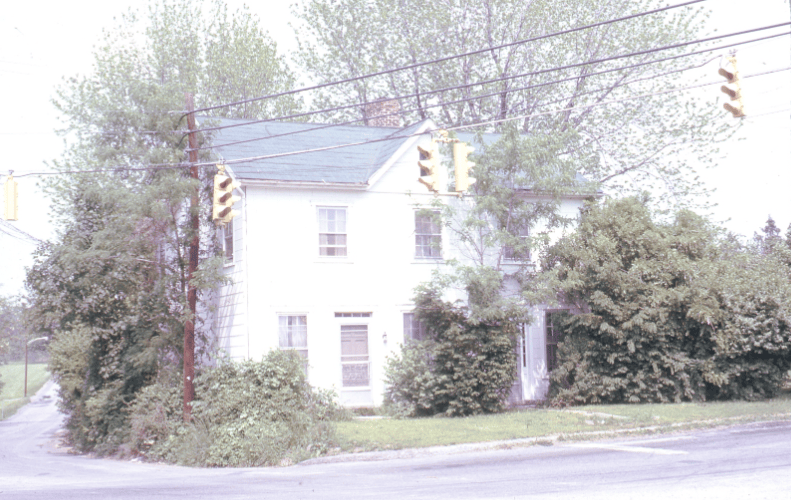
When I began looking into news stories from Beallsville in the late 1800s, the story of this log smokehouse became much more interesting. On May 2, 1877, Lemuel Beall – a farmer living in Beallsville – reported that meat from his farm had been stolen from a smoke house and Beall publicly named Henson Ames as the thief. As noted in the article, Ames was a “known desperado” in the area. Angered by this public callout, Ames approached John Belt at his store looking to confront Beall – the article alludes to the fact that Beall was either living in the home where the store being run or immediately next door. Ames was carrying a branch from a sapling tree and notes his plans to murder Beall with the club.
Initially refusing to leave his home out of understandable fear, Beall did decide to eventually leave the home and confront Ames – while carrying a pistol. Upon emerging from his home, Beall was immediately attacked by Ames and a significant fight ensued. While Beall was able to fire his weapon, he was unable to hit his target while engaged in the scuffle. Just before being overtaken by Ames’ heavy blows, the article notes that Beall was able to land a strong uppercut, knocking Ames backwards where he fell and broke his neck (author note: this seems suspicious, but who am I to judge to a 144-year-old news story?). Immediately following the exchange, Beall jumped on his horse and rode into Poolesville to turn himself in to the authorities.
Is it possible that the smoke house in the news article is different than the one still standing at the 4-way intersection? Yes, but given the references to John Belt’s store and other sources confirming that Beall had lived with or near John, it seems highly likely this is the place. My hope is that over the coming weeks and months I can work with the owner of the property to identify how best to ensure the structure remains preserved.

