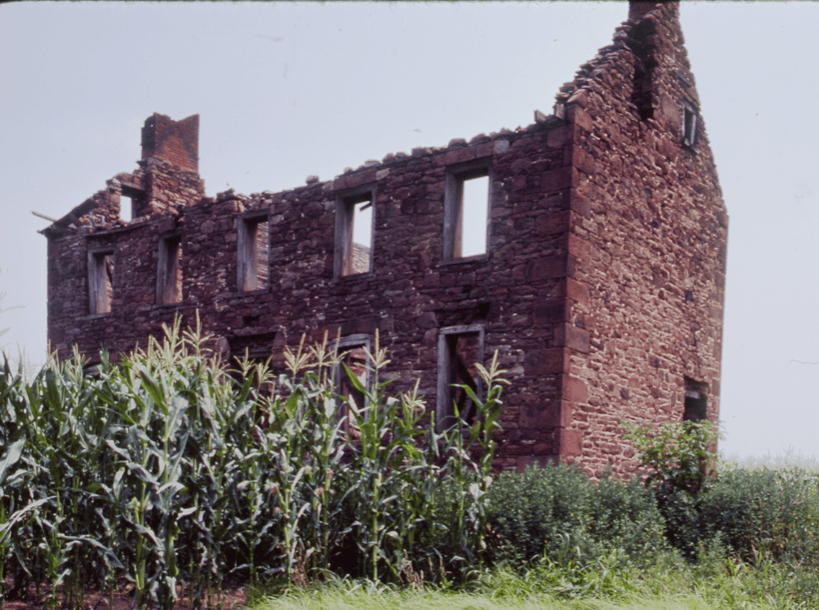
A few months ago while looking through some old photos of historic homes in the area, I came across a picture from the early 1980s of a stone home in a ruinous state located near the Sugarland community (close to where Sugarland Rd. crosses the Dry Seneca Creek). Curious to know more about the home’s history, I began further research and was able to figure out that the home had been built by Robert Dawson around 1808.
Robert Dawson was born in Dawsonville in 1758. He joined the Army in 1776 after heightening the heels of his boots to meet the height requirements. Robert fought in some of the biggest engagements of the Revolutionary War, to include the Battles of Long Island, Cowpens, and Germantown (where he was severely wounded).
Following the war, Robert married Sarah Newton Chiswell (the daughter of Stephen Newton Chiswell – builder of “Chiswell’s Inheritance”) in 1781. Between 1781 and 1806, when Sarah died, the couple raised 11 children. It’s a bit unclear where they were living during this period, but there are some indications there was a modest home located near the site of the large, 4,000 sq ft stone home Robert later built in 1808.
It’s this 1808 stone home that is incredibly interesting. As the story goes, the home was built for Robert’s second wife, Henrietta. That said, the two weren’t married until 1811, when the home appears to have been three years old. According to legend (mostly passed down through stories), the couple never lived in the home, but nobody knows for sure why. One theory is that Robert’s children from his first wife (and possibly other members of the Dawson Family) weren’t huge fans of Robert’s new wife, and refused to join them in the new home. For whatever reason, this rift apparently resulted in Robert and Henrietta living elsewhere, where they raised three children.
Purely an observation and open to many interpretations, but Robert and his first wife Sarah are buried next to eachother at Monocacy Cemetery with their children buried nearby, while Henrietta and the three children she had with Robert are buried in a separate plot.
When Robert died in 1824, his land holdings (776 acres) and the home were divided among four sons. The sons continued to farm the land, but there’s no clear evidence that any chose to live in the stone home. By 1875 another home north of the stone home had been built by one of Robert’s grandsons (the home is still there today). It appears that this new home was where many members of the Dawson and Allnutt families chose as their residence over the years.
So, did anyone ever live in the stone home built by Robert in 1808? It seems likely that at some point members of the Dawson Family, which was rapidly expanding through the early 19th Century, would have occupied the home in at least a temporary basis. Additionally, the Sugarland Ethnohistory Project, led by Gwen Reese, has a picture of the home from the 1970s that is labeled as “slave quarters.” So, it’s also possible that some of the enslaved labor Robert and his sons used to cultivate the 776 acres lived in the home as well.
The greatest details we have on Robert’s home come from a 1936 survey conducted by members of the Works Progress Administration as part of their Historical Records Survey. The WPA also developed architectural drawings of the home, which are pretty awesome in helping you visualize the layout.
Although no longer with us, I’ve been told that at least some of the stones from Robert’s home were used in the construction of a relatively new home (built in the 80s or 90s) on the property.
You can see more pictures of the home in the Property Explorations section.

