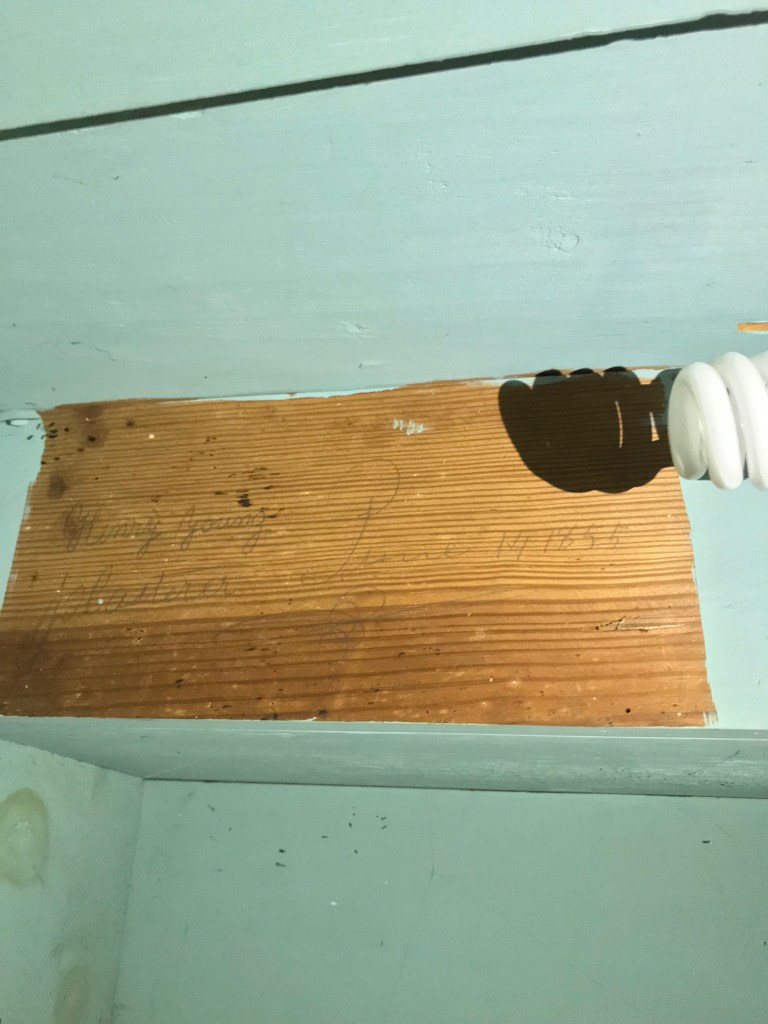
On June 14, 1855, Henry Young put the final touches on his plastering work at Upton Darby’s new home, signing his name and date on the back of the main staircase. 164 years later, Henry’s mark remains, as clear as if he had written it yesterday.
When I drive down River Road and past Upton Darby’s home each morning, I always turn my head to grab a quick glance. I’ve always wondered what the inside might look like. A few weeks ago, I was finally given the chance to take a look. It did not disappoint.
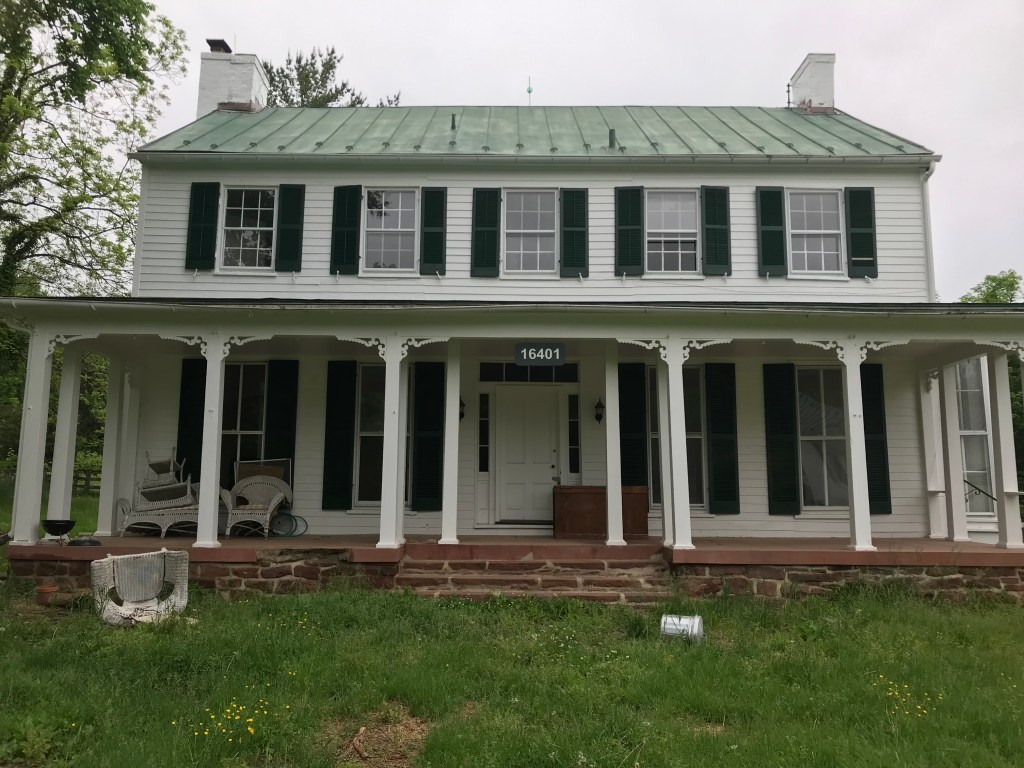
But before talking about the interior of the home, let’s go back to 1855. John Darby, a local trader, built this home on 93 acres along the Seneca Creek. John and his son Upton owned and operated the Seneca Ford Mill right next to their home (where present-day River Rd. crosses the Seneca Creek in front of Poole’s Store). In June of 1863, there was a skirmish between Confederate and Union troops, resulting in a fire at the mill. A few years later, another fire caused significant damage to the site.
While initially profitable, the Mill appears to have fallen on difficult times in the fourth quarter of the 19thcentury, likely related to the decreasing profitability of transporting goods on the C&O Canal relative to the B&O Railroad. In 1900 the property and mill underwent foreclosure and changed hands to Wilson Tschiffley who quickly sold the home to Frederick Allnutt (who built what we now know as Poole Store in 1901) but maintained ownership of the Mill. The Allnutts remained in the home until sometime in the 1970s or 1980s.
With permission from Montgomery County authorities (the county now owns the home), I was thrilled to step inside. Although empty, and clearly needing a bit of work, the home’s beauty is immediately apparent. The foyer includes a beautiful main staircase – similar to other homes I’ve seen in the area – and the main hall is flanked by two large rooms, each with a marble fireplace. The original wood floors throughout the home have been salvaged and meticulously re-laid by county employees in the last few years to correct for some warping that had occurred. The second floor has large bedrooms, also with fireplaces, and an interesting small stairwell leading to the attic.
In both its layout and architectural elements, the home is incredibly similar to the large white home on Elgin road near the center of Poolesville (see the Historic Ag Reserve facebook page for more details on that home). Although built 30 years apart, it’s possible that the same builder was involved in both, or the same architectural plans were used.
While the architectural details and history of the home are interesting, Henry Young’s signature on the back of the stairs is the part of the home I keep thinking about. Who was Henry? What other local homes did he work in? Are there other staircases in the Ag Reserve where his signature has been painted over?
I’ve spent some time trying to learn more about the identity of Henry over the last few weeks. While it’s a fairly generic name, I’ve only been able to find one Henry Young in the Ag Reserve who was alive during this time period. What is somewhat odd however, is that this Henry Young was from the wealthy Young Family, who built and lived in the East Oaks Estate out on White’s Ferry Road. Why would this Henry be involved in plaster work at Upton’s home?
In 1855, this Henry would have been 36 years old, and we know from records that he was married to Sarah Ellen Allnutt Young. Sarah’s brothers owned and operated farms in the Seneca area near the site of Upton’s home. So perhaps Henry and Sarah spent time in the area and the plaster work was just the result of one friend helping out the other with some handiwork. When I think about all the different friends from throughout the area who came to help my wife and I renovate our home a few years ago, this idea seems plausible. A lot has changed in the Ag Reserve over the last 164 years, but the idea of helping your neighbor has certainly not.
Ultimately, we will probably never know for sure which Henry Young signed his name on those stairs. But regardless, it’s hard to imagine that whomever he was, he would have expected us to be talking about the mark he left so long ago. Which begs the most interesting questions: what are the marks you’re leaving that might be discussed 164 years from now? And, are they the ones you’d expect?

