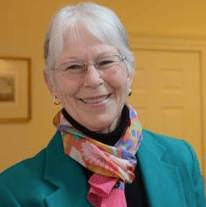
Interviewer: Amy Baker
Date: 3/4/2020
You mentioned that you moved to the area as an adult. What brought you to the Ag Reserve?
- I worked for the Department of Energy in Germantown and had lived in Frederick in a Victorian house on half an acre, and was collecting dogs and horses. When the board bill for the horses began to exceed the mortgage, it seemed like it was time to move to a farm. I’d never lived on a farm, but I was married at the time and my husband had some experience helping out on a farm. We started looking and found 60 acres outside Boyds and moved our horses and dogs and began to be farmers, on the side, in addition to our full-time jobs.
- It was 1980 and the Ag Reserve had just been established. I remember saying “I give it 10 years and then the developers will have convinced the County Council to abandon it.” That was the climate of the times, and I really didn’t think it would last more than 10 years.
- My husband and I divorced, and I wanted to keep the farm, which by then was 90 acres, but there was no way I could afford to pay him for his half of it with my savings. At the same time, around 1980 or so, the County was developing an agricultural easement program. Money from transfer taxes on agricultural land went into a fund that was available to buy easements on farms in the Ag Reserve, with the objective of protecting open space. The Ag Reserve Zone allowed one house per 25 acres, but gave the owner one Transferable Development Right for each 5 acres. The easement program would buy up your right to build in perpetuity. There was also a state easement program at that time, but it required you to have 100 acres, and the County’s limit was smaller than that, so I applied. There was a formula that included how many Transferrable Development Rights you still had, what your road frontage was, how close you were to the Ag Reserve boundary, quality of soil, and how much land you had. I think I was the first one who actually went through the process and sold an easement, and so I was able to pay my husband for his half of the farm and keep it.
- At the time I had to pay someone to farm part of the land in grain. Part of the farm was in small grains like corn, wheat, and soybeans, and lot of it was in hay and pasture for the horses. It was not a winning proposition to pay someone else to plant, fertilize, harvest, combine, and haul crops off to market.
- At some point I had a neighbor whose profession was repairing equipment: all the way from chainsaws up to the biggest combines we have in the County. His name was Earl “Dilly” Dillehay. He grew up in Boyds on Barnesville Road across from the Boyds Store. He wanted to get into farming and asked if he could lease part of my land to farm it. I was reluctant, because I didn’t want to have somebody else be responsible for the health of the land, but ultimately, I felt like he was somebody I could trust. I leased him part of the land, and he did small grains for a few years, and then he switched to hay. He leased more of my land, and also made hay for me on my share of the land. When he died, his son, who had moved back to the area having finished his Ph.D. in Agricultural Engineering at Penn State, took over and still makes the hay to this day.
- So that’s where we are now. I have 90 acres. I have one horse and board several more for friends, and Bryan Dillehay makes the hay that I feed my horses and also sell. I sell most of it because I have the pastures and don’t need much hay.
When you moved to the Ag Reserve it was just being formed. Do you remember what the general feeling was about it being established?
- Farmers did not love it. For many, selling the farm for development was their plan for retirement. I spent 6 years on the Ag Preservation Advisory Board in the 1990s. There are two County boards that deal with Agriculture. One is the Ag Preservation Advisory Board, which had some farmers and some non-farmers, and then there was the Ag Advisory Committee which I believe is all farmers. Both advise the County Executive. The Ag Preservation Advisory Board was the one that oversaw easements and tried to protect the Ag Reserve. The County is often not careful about issuing building permits to people. And sometimes we would catch things.
- For example, the Ag Reserve Zone allows lots for children of a farmer that are called children’s lots—“kiddie lots.” If a farmer has 3 children and lives in the Ag Reserve, he has the right to build 3 lots for those children to help him farm. What was happening was that people were establishing children’s lots and then selling them immediately. I think now they’ve changed it, so if the child has lived there for 5 years, then they can sell it. There will always be challenges. I remember one family who ended up giving a child’s lot to a grandchild, which is not legal– it’s supposed to be for the children. And I think what he ended up doing was repaying the county the easement money for that part of the property.
What challenges does the Ag Reserve face today? Are they similar to the ones it faced when you first moved here?
- They are constantly evolving! Now the challenges are things like alcohol facilities, event facilities, solar arrays. There was another thing I thought in the 1980s when the Ag Reserve was established: this is setting up an area of the County where there are very few voters. I was concerned they were going to put everything here that they didn’t want Down County—the incinerator, the landfill, I expected a bus lot, the jail is in Clarksburg, where there isn’t even public transportation to get people from Rockville up to the jail. It’s telling. That was my view then and I think for the most part I still have it.
- The County wanted to close Monocacy Elementary School because there were so few children to go there. Yet the whole idea of the Ag Reserve was to limit the population! We should not lose our schools because of that. And it is unconscionable that Poolesville has not had a new high school. You go Down County and look at all the splendid new construction and then here’s Poolesville, a magnet school and one of the best schools in the state—it’s unconscionable. But I think it’s because we don’t have as many people who live out here. And then the superintendent comes out here and says, “Yes, you do need a new school, but you’re going to have to make it a school and a bunch of other things.” I think it was so we’d have to get money from other departments, but then the Fair Access Committee turned it around and gave them a terrific proposal.
- Those are all challenges for the Ag Reserve, especially since there aren’t as many voters out here. I think it is not fair that the County Council member who represents us lives in Germantown and is focused on Germantown. And the four at-large Council Members live in Silver Spring/Takoma Park right outside the district line. It would be wonderful to have someone who lived out here and is knowledgeable about the Ag Reserve to at least be a voice on the Council. I don’t think over the years we’ve gotten more of a voice. But I do think the County Council, year after year, has been astonished about the strength of this part of the County. They’re smart, they’re educated, they’re assertive, they’re litigious, just like the Down County people, and I think the Council has been surprised about the pushback they’ve gotten from us over the years about many things.
- One of the latest challenges came from the legislature in Annapolis—a delegate from Damascus, who is actually the majority leader in the House of Delegates, introduced a bill to allow deer hunting with rifles in the Ag Reserve through the deer management program, which means 365 days a year. People said we weren’t going to beat that, but we said we’d try. Thanks to Montgomery Countryside Alliance putting together a link so that people all around the County could see what was being proposed and contact their legislators, the sponsors of the bill backed down and will do a summer study. The deer are a problem, we all agree that they are a problem, but let’s be rational about the solution.
- Full disclosure: I’m on the Board and Executive Committee of the Montgomery Countryside Alliance and have been for 2-3 years. Caroline Taylor, our Executive Director, is a dynamo, smart as a whip, and very hard working.
How would you describe the changes that you’ve seen in the Ag Reserve and the town of Poolesville over the last 40 years?
- Housing construction for sure. It was very discouraging that the very large tract of land over on Peachtree Road and White Store Road got developed.
- I should mention Mike Rubin. He owns probably 3,000 acres in the Ag Reserve. He got started riding his horse in the Hunt in the 1990s or 2000s and got interested in the area. Then he started buying up farms that came up for sale and selling conservation easements, and splitting off the house and 25 acres for resale, but with no development rights. He didn’t want to keep the houses to rent, and people bought the houses that went with many of the farms. He’s protected 3,000 acres of the Ag Reserve, with conservation easements, and with the understanding that when someone buys the property people will be able to ride and fox hunt in the area.
- Mike tried to buy the (Peachtree) property of 850 acres but could never even get to the owners. The people who owned it were some part of the Saudi Royal Family. They had owned it since 1980 and when they decided they were going to sell it, it was done through a friend and a big housing developer. The Planning Board allowed the developer to cluster the houses instead of requiring them to build each one on 25 acres, making it easier for the developer.
- In 1980, Rockville Crushed Stone owned 1800 acres surrounding my farm and they wanted to build one or more quarries in Boyds. They had bought the land before I did and had offered to buy my farm because it was right in the middle of theirs. I was very worried that we would end up with a quarry in Boyds and dump trucks on the roads and more trains.
- Ultimately the people that owned it decided they wanted to subdivide it and build around 500 houses in Boyds. The Boyds Civic Association established a Bardon Committee (Bardon was the company that owned the land; Rockville Crushed Stone had been bought by bigger and bigger corporations.) We met weekly for a couple of years, sometimes it was just with ourselves and sometimes it was with Bardon. We went to charettes and went to the Kentlands and planned developments in Virginia. We worked on it for a long time.
- Then down the street from my property is the White-Carlin House that dates to around 1802, and Rockville Crushed Stone owned it with 125 acres. They had some employee living in the house and it was in shambles; there was a huge bank barn that they were letting fall to ruin. The property was historic and at some point, the County started fining Bardon for letting the barn go. Bardon spent a lot of money shoring up the barn. The company decided they wanted to sell the house and 125 acres, and I told Mike. It took some doing, because the real estate agent had a buyer who wanted to develop it, but Mike ended up getting the 125 acres.
- He sold the White-Carlin House and 25 acres to the Bergmanns who have done an amazing job restoring the house. I have been in awe of what they have done. The house had been in shambles, people had taken out the mantles, and somehow, they got them back. It’s beautifully restored now. They did a very appropriate addition to the house, and had experts come and stabilize the foundation. (Note: See https://historicagreserve.wordpress.com/property-explorations/white-carlin-farm/ for more on the White-Carlin House)
- The Bardon property was partly in the Ag Reserve and extended from Seneca Creek, and the County had said they were not going to bring well and septic across the creek. Bardon knew that to get any kind of agreement from the County for a building permit, they needed the citizens of Boyds to say this is our proposal together. So that’s why they were working with us, and we were working with them because we wanted to have our say in it. We worked with them for two years, but ultimately, they decided they were done.
- They approached Mike to see if he wanted to buy the rest of their land. He didn’t want to buy all 1700 acres, but he brokered a deal. He got American Farmland Trust to put in money, he put in money, and I think the State put up money. All of the land west from White Ground Road, Mike owns except for some of the houses that he sold. On the other side of White Ground Road all the way to the Soccerplex is Hoyles Mill Conservation Park, which I believe the State bought and gave to the County.
- After that, the people of Boyds organized a Mike Rubin Day Picnic to thank him for saving our community!
- The biggest change for me in the town of Poolesville is how many new housing developments are here now. I don’t know how many people who have moved into the new houses think of themselves as Poolesville residents and how many people are still oriented Down County. Selby’s Market is also a huge thing that is gone and I really miss it.
You mentioned that you were a member of the Hunt. Could you tell me more about the Potomac Hunt and its history?
- It originally started in the late 1700s when they hunted downtown [Washington D.C] around where the Willard hotel is— that was the country back then! There was a hotel there, and they would go fox hunting and then come back to it. As the area grew, they kept moving out of the city to Potomac eventually, and then in 1980 they sold that property and moved out to the current property on Peachtree Road in Dickerson/Boyds. The Hunt owns the property with kennels, a barn, and a clubhouse, a house for the huntsman, and a pack of foxhounds that get exercised every day and then go hunting a couple of times a week from September through March.
- There is a professional huntsman who is responsible for the care of the hounds, the breeding and training of the hounds, and the hunting of the hounds. We have about 70 hunting members, some of which are family members, so that could be a husband and a wife or parents and children. We have an equal or higher number of associate members who don’t ride but support the Hunt and come to the events.
- One of the fundraisers we have every year that has become quite a community event is we host the Hunt Races out on Partnership Road on the Kiplinger estate. It is steeple chasing for the day; it’s a lot of fun and a traditional fox hunting activity. Many hunts host hunt races in the spring.
- Fox chasing (we are not out to kill foxes, only to give chase) is an activity that I love. I have been a member since 1979. It’s a lot of fun to ride to hounds and go where the hounds go as they follow the fox. It’s not a trail ride, and it’s unpredictable and challenging, but fun. Every time is different. I try to go twice a week. We used to go three times a week, but we’ve lost territory—either a house has been built or property has been sold and the new owners no longer want us on their property. We leave from different places, and arrangements have to be made and permissions obtained. We call the landowners to say we are going to be in your area that day. If the hounds are leading to a place where we’re not supposed to go, then the idea is to stop them, and if you can’t, then you can at least stop the riders. A typical hunt lasts 2-3 hours and then afterwards we usually have a tailgate, and everyone brings something to share: cheese and crackers, dips, soups when it’s cold, and sometimes someone stops by Dickerson market and brings fried chicken.
- We’re getting a few new members, but not as many as we would like. We would like more hunting and associate members. We don’t have as many kids as we would like either. There are two Pony Clubs in the area – Potomac Pony Club and Seneca Valley Pony Club. Pony Clubs grew out of hunts in England. They were established to teach children to ride and it was meant to be cross country eventing and fox hunting as well as dressage and stadium jumping. The kids do still learn to event, but it’s a more controlled situation that fox hunting is. We typically don’t get a lot of kids from the Pony Club, even on Junior Days. We would love to have more.
Looking ahead, what do you see as the future of the Ag Reserve?
- My hope would be that it stays pretty much the way it is, open for horseback riding, hiking, bird watching, bicycling.
- There are people who see an evolution of agriculture from commodity farming to smaller scale table crops. I don’t see that on a large scale. To do large scale table crops, you need a substantial amount of basically low-wage labor, which I don’t see happening. Montgomery Countryside Alliance does try to match new farmers who want to work one or two acres with farms who would let them have that. I don’t know why we can’t continue to do commodity farming here. Most dairy farms, however, are gone. I believe there are only two dairy farms left—the Savages and the Johnsons.
- I worry that whoever is on our County Council will keep making incursions into the Ag Reserve. I think the only way to protect it is eternal vigilance. There is a move afoot to have 9 County legislative council districts, instead of having 5 with 4 at large. I think if we had a voice on the County Council, it would be helpful.
- What’s the next incursion? I don’t know.

