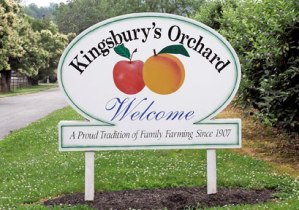
Interviewer: Lennon Gross
Interviewee: Gene Kingsbury
Date: 6 July 2020
How long have you lived on the Ag Reserve?
Pretty much my whole life, I mean I moved out to the farm when I was seven so since the early sixties.
Have you always lived in the Poolesville area?
Oh yeah, right on the farm. My current house is about two miles away but it’s still on Peachtree Road. I pretty much still live on the farm.
What is the biggest difference between when you first moved here in the 1960’s and now?
One thing is that the Ag Reserve has helped a lot to lessen the pressure for development. When I was a kid, my great grandfather owned the farm and there were developers after him even back then. So in the sixties and seventies. Then of course the Ag Reserve started in 1980 and immediately it seemed that we saw a decline in the amount of pressure to develop. You know, we’re fruit farmers, so the fruit farming has changed – there are a lot more varieties, a much more extended season. I mean, my great-grandfather would have peaches for about a month, that was all they had back then. Now peach season lasts about three months. In a good year – I don’t know if you hear, but we had a really bad year with the trees damaged in May. We lost most of our peaches and apples this year.
I’m so sorry, I hadn’t heard about that.
Yeah, it was a disaster, and you get that from time to time. You have to be prepared for that when fruit is what you do. It’s not like growing vegetables or something, where you wait until after the freezes are over and then you plant your crop. You can always have hail and drought and rain – all those things. But freeze damage has been really bad these past few years. The other thing we’ve noticed is the difference that climate change had brought. Climate change has altered our seasons quite a bit and we’ve kind of had to adapt to that quite a bit.
How so?
Well, we’re not getting – fruit trees tend to run better when we have a full cycle. Fruit trees tend to run better when they have a nice cold winter where it stays a steady cold and in the Spring where they do their bloom phase. But with climate change, what we’re seeing are these warm spells. We still get cold weather but it’s these unusually warm spells in January and February and it makes us bloom too early in some cases. That’s why we see more fruits getting freeze damage, so I’ve changed the way I plant my crops. It didn’t help us this year but it’s improved – putting my peaches and plums on higher elevation and apples at lower elevations because apples bloom later. So those are the kind of things that we’re doing to change and adapt to the climate.
That is really cool, I have to tell you, I don’t know much about growing fruit but that is really interesting.
Yeah, there’s a lot of things you can do to mitigate the issues but this year was just a disaster. And you know, we’ve never lost fruit – usually our tough time is the last week of March and the first two weeks of April – once you get past mid-April (and I’ve been doing this since I was seven years old) you’re good to go. We’ve never had an issue past April 15th, but this year we lost our crop on May 9th and 10th.
I mean, we just weren’t ready for it. The crop was already set up, the trees had fruited, it was a bumper crop and those two cold nights came through and we were just really amazed. So, you know what we did, we had a cherry crop so we opened up with cherries this year. We actually sold the last cherries yesterday. We’re going to close our market for a couple of weeks because we just don’t have anything. We’re going to re-open in late July with peaches. We have mid-season peaches and Asian pears too, but I lost most of my apples so we’re going to close again at the end of September and have a very abbreviated season.
But that’s a one-off. I mean, my family’s been here for over a hundred year and you’re going to get – hopefully it’s just a one in a one-hundred years occurrence.
So, in terms of – since you said your family has been here for over a hundred years – what is a family tradition that you might have passed down, or something that you-
Oh, peaches. Peaches is our thing. My great-grandfather – I always tell people – my great-grandfather was like the peach guru. That’s come through the genes somehow to me. Because actually, you know, since my great-grandfather, I’m the one who really took it over and did something with it. My grandfather, my great-grandfathers son, was not that interested in farming. So he didn’t stay. My parents took it over after my great-grandfather retired. My dad was more of a dairy farmer but my mom saw this as a family legacy and wanted to keep going with the orchard. They kept it going until I got old enough to take care of it. I’ve really been running the orchard since I was like sixteen.
Yeah, because my dad was more into the dairy farming. But you know there’s hardly any dairy farms left in Montgomery County now. But that’s what he grew up doing so that’s how he knew to make a living and he helped keep the orchard on life support, but it wasn’t nearly as big back then. Most of the farm was dedicated to dairy. So back then we probably had about ten acres of fruit trees and now we’re up to about sixty acres of fruit trees. For years, all we did was peaches. It was a pretty short season, but I’ve added all kinds of fruit trees. So just about any kind of fruit that you can grow in this area, we’re doing it now.
Can you think of a prominent event or occurrence that’s happened that caused a lot of stir in the town or anything specifically regarding the agricultural reserve?
Not any specific event, no. I can’t say that I do. I mean, it was kind of interesting, I remember when they implemented the Ag Reserve and you would think that farmers would be really keen on getting it in place, but I don’t remember that being the case. I remember other people were opposed to because they saw that it would diminish the value of their farm land – which it did. But my family was in favor of it. There were a lot of farm families in the area, I remember from that time that weren’t that much in favor of it. They were taking a hit to their value of their retirement.
Can you think of any ways that the shifting to the Ag Reserve either caused people to move away or change their way of life? Did you notice a shift when it officially changed over?
I’m sure it’s enabled a lot – like myself, I mean, I wouldn’t be farming today without the Ag Reserve, there’s no way we could have kept it going. If they hadn’t implemented the zoning changes and I’m sure that holds true for a lot of the older farm families. Even my neighbors, the Lewis’s. I doubt they would be able to stick with it either without the Ag Reserve.
Are you concerned with any of the new development around Poolesville?
Yeah, absolutely. You have to be vigilant all the time because for years I’ve been – I used to work for the Federal Aviation Commission downtown but when I retired, I joined the Montgomery Countryside Alliance because I was concerned about that. There’s always things cropping up that pose challenges to the Ag Reserve, so we’re lucky to have the MCA being our watchdog in the area as some of these things come up.
Can you talk about some of the challenges?
G: I mean, everybody loves the little town of Poolesville but at the same time you have to watch how you’re annexing additional land to incorporate into their town and what that might mean. There’s a concern that if they get too big, they might have more water and sewer issues and that could impact the total Ag Reserve. So, things like that and the way people develop. One of the things that was contentious a few years back – I don’t know if anyone’s talked to you about this – were the people taking advantage of Tot Lots. Had you heard of that one?
I haven’t.
I was mentioning some farm families weren’t too keen on the idea because they saw that taking away from the value of their land. So a lot of farm families were doing what was called Tot Lots, those were special exceptions that were built into the zoning rules that allowed farm families to allocate certain lands – additional units – special development rights for their kids because they didn’t want farmers to give up that right. They wanted to make sure that if they have kids that live on the farm they could build and have an extra development for that. So, a lot of farmers started applying for what they called back then Tot Lots, and then the farmers never moved into the homes so they were like – this was their way of getting their own little developments. And that was getting out of control at one time and that was something that the MCA intervened and was successful in turning the tide on that. But those are the kind of things that you have to watch out for.
Do you remember about what year that was that this was taking place?
Well let’s see, I guess that was really like in the 90’s and right around 2000 that I was seeing a lot of that.
So we just had the Fourth of July, can you remember any big celebrations whether it was on the farm or in town – just anything community oriented that used to happen?
G: Well, there used to be. The big thing when I was a kid was we would always have the Beallsville Carnival but then they don’t do that any longer. Do you know where the Beallsville Fire House is? Yeah, the Fire Department used to put on – as a fund raiser, really – they used to put on a carnival every year. These were more common when I was a kid. All the fire departments in the area used to have carnivals but they no longer have those in the area.
What was the interconnectivity like between communities like Beallsville and Poolesville?
They’ve always been pretty connected. Probably more so back in the day than now since there’s so many more people that have moved in. But years ago, everybody knew everybody out here.
Anything else you’d like to mention?
Years ago, when my grandfather took over the farm from my great-grandfather, it was passed on to him, and he still lived in the area but he didn’t work the farm. They had come through and there was a very old house that my great-grandfather lived in that was all log underneath, had a dirt basement and weatherboard had been nailed to the outside of it. That’s where he had lived pretty much his entire life. But after my great-grandfather died, they condemned it. But my grandfather didn’t want to tear the house down so he went and tried to make it a historic landmark in Montgomery County.
So they did a lot of research because there was some interest as to whether that house was the original house that was on what was then called the Chiswell property. So, the guy who did all the research back in the seventies left all his notes with us and I still have that binder from the seventies with the interviews he did on some of these older people in the area all about the history of the farm. He was never able to determine whether that particular foundation was the original – which I think dated back to the 1730’s.
But, I can tell you it was old because I remember it very well. Like I said, it was all log underneath but my great-grandfather lived there until he passed in ’67, I think. The guy who did the research, that was in the 70’s, but there’s one thing in particular that’s really interesting. He interviewed – see, my family bought the farm from what is now the Lewis family, back then they were known as the M, but that’s written up in there, but he interviewed Mrs. Lewis. Robert Lewis is the current owner but it would have been his grandmother, about what she remembered about those properties. And she goes into it. There was a Bethel church that was more on the Lewis property but it was right adjacent to our property. There was a church there I guess back in the 1800’s. She goes into it, some of that’s kind of interesting. (Interviewer Note: We are conducting more research on this old home and will publish the findings soon).

