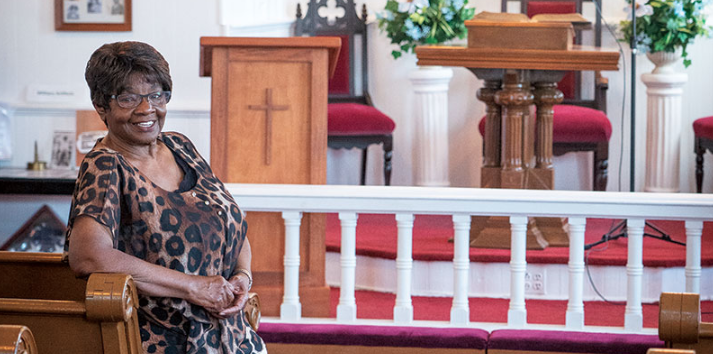
President, Sugarland Ethno history Project
Interviewer: Kenny Sholes
Date: 3/9/2020
How did you end up in the Ag Reserve?
Gwen notes that to understand how she ended up in the Ag Reserve, you’d have to go back to slavery, when her ancestors worked this land. Following emancipation, a community of former slaves was established at Sugarland, where Gwen grew up with 12 siblings (6 boys, 6 girls). Gwen’s mother was a housekeeper and her father did construction-related work throughout the county.
Could you talk about your educational upbringing in the Ag Reserve?
Growing up in a time of segregation, there were limited schools to which Gwen could attend. She began elementary school in a school in Sellmans (close to Barnesville) and then attended Taylor Elementary (in Boyds) beginning in sixth grade. After Taylor, Gwen attended Lincoln Junior High before heading on to Carver High (both in Rockville) where she was focused on a trade (cosmetology).
During Segregation, could you talk about the interactions between your African American community and Poolesville?
Gwen notes that for the most part, the two communities kept to themselves. There were plenty of times when members of her community would travel into Poolesville to purchase necessities, such as feed for animals. Gwen remembers the first Selby’s Market with wood floors, the Williams’ store where she would buy ice-cream sandwiches, and the Seneca Store (she referred to it as the Allnutt Store) for feed.
But the Sugarland community was largely self-sustaining. Everyone worked together to share resources, nearly all families had their own gardens to grow vegetables, and canning of food was a community activity. Within the community there were numerous fruit trees, walnut and other nut trees, berries such as, blackberries, raspberries and an assortment of other berries. Gwen wonders if they were planted by the founding community families or were naturally there.
Additionally, Gwen mentioned that the community engaged in partnerships with local farmers for resources they didn’t grow on their own, such as apple walnuts. Through these informal partnerships, the community was permitted to glean the fields after they had been harvested. They had a much larger variety of vegetables.
Ultimately, Gwen doesn’t remember too much conflict between these communities during segregation, although there was definitely tension in the first few years after segregation when members of the Sugarland community began attending high school at Poolesville (Gwen mentioned her cousin being part of the first PHS de-segregated class and having a rough time).
What was childhood in the Ag Reserve Like?
Gwen remembers playing lots of games with family and friends: dodgeball, baseball, “Mother May I,” jacks, pick-up sticks, egg-carry races, John Brown’s Body in piles of leaves, and dolls. Gwen also said that she and her brothers and sisters had a daily load of chores and housework that took up a good amount of time.
Church was the center of community activity. Most Saturday’s were spent cooking for community meals that would occur after church service on Sunday. Through the church there were fundraisers (Gwen remembers frequent pie competitions), homecoming events, and general gatherings. Food and church were a big deal. Gwen remembers that her aunt was known for her caramel cakes and her mother was known for her homemade biscuits.
Growing up, do you remember significant events or issues affecting the community?
Gwen commented that serious issues were not discussed around children. Whenever adults were going to discuss a serious matter, they would send the kids outside or they would speak to eachother in pig latin to disguise what was being discussed. As a result, Gwen doesn’t remember many serious issues and notes that she’s faced many issues in her own historical work uncovering events because little was written down.
In 2080, what do you think the Ag Reserve will look like?
Gwen hopes the Ag Reserve is still intact in the same ways it is today, as she believes the Reserve protects the communities that are located within.

